Race simulation
Eight runs. Eight stations. One split table.
Log a full race simulation station by station, keep every run split next to the work that follows it, and get a finish-time estimate you can actually plan a race around. Then log the strength work that gets you there — in the same history.
Free plan, no card. Premium included through launch.
A first-class session type, not a note in the cardio log.
The format
Every kilometre, every station, in order.
Eight one-kilometre runs, each followed by a station. Log the run and the station as the paired effort they actually are, so you can see which transition is costing you the race.
1 km run
1 km run
1 km run
1 km run
1 km run
1 km run
1 km run
1 km run
8 km total
8 stations · every split logged
Loads and distances vary by division — set yours once and the simulation follows it.
Race time predictor
A finish time, and the splits behind it.
Set your category, your 1 km pace and your level. You get a finish estimate with a realistic range around it, an approximate percentile, and the split that decides most races — how much of your day is running and how much is stations. Then a full table, run by run and station by station, that you can save as a race goal.
Open or Pro, either sex. Sits alongside heart-rate zones, VO₂max and running pace in the same calculator set.
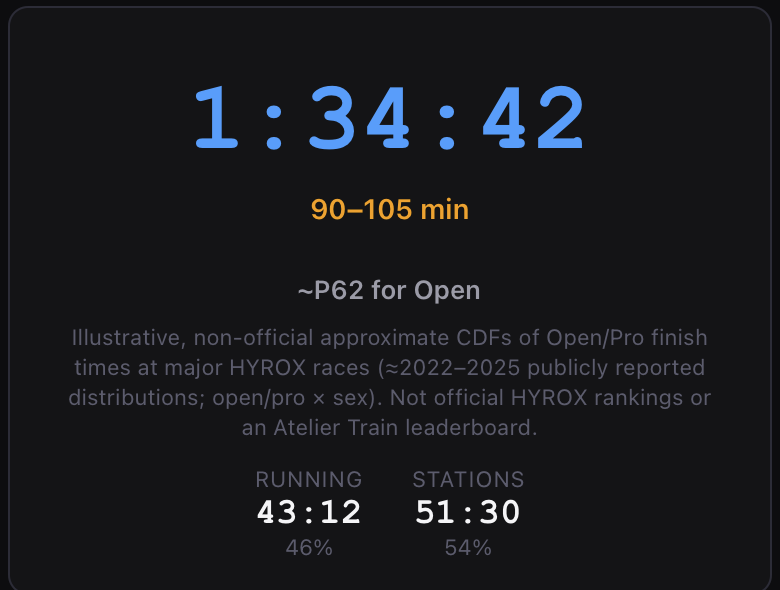
Where the day actually goes: 46% running, 54% stations.
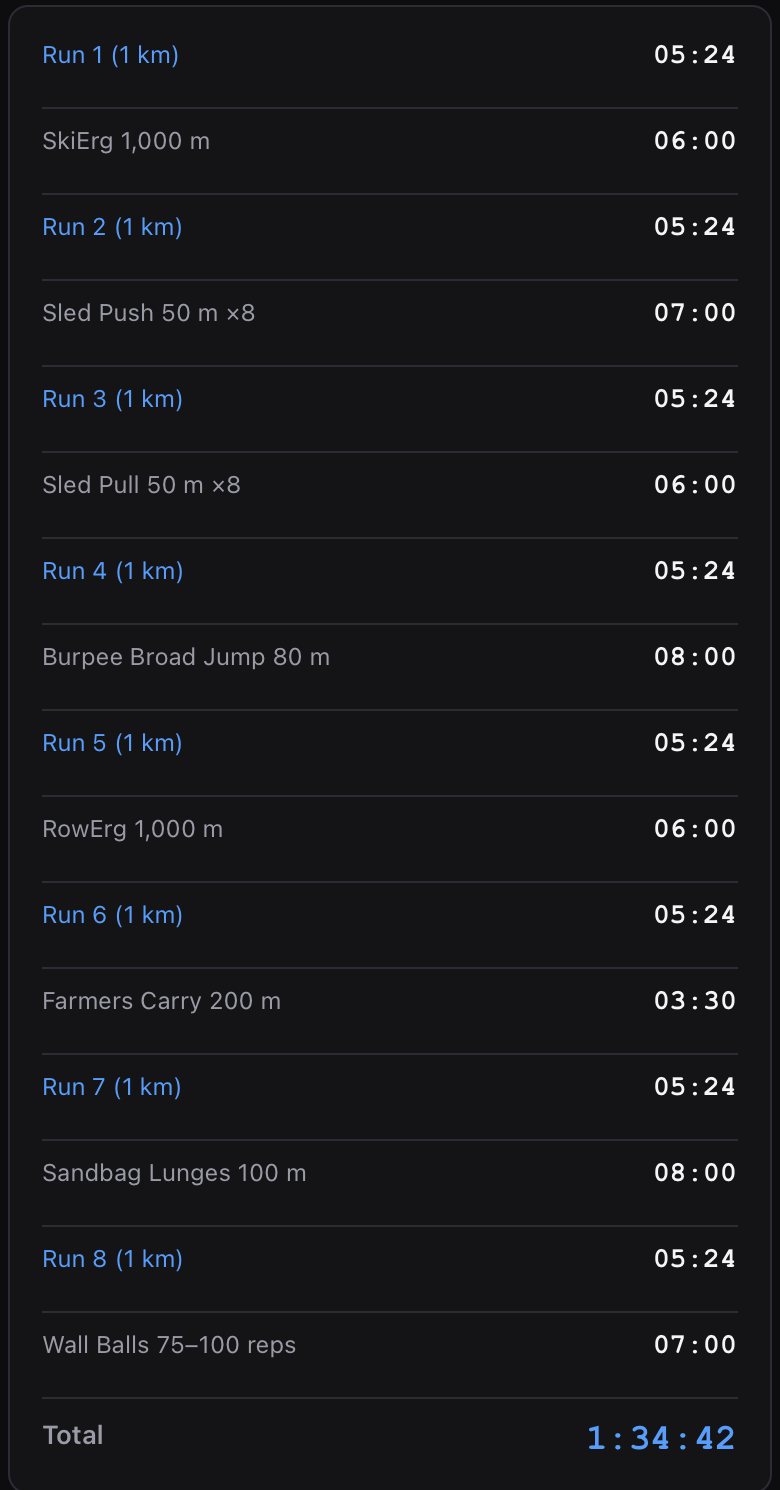
Every leg, down to the second, through to the total.
The session
Sixteen segments, one running clock.
Eight runs and eight stations, logged segment by segment while the timer runs. Division weights sit on the station itself, so you are not checking a rulebook mid-race. Finish with session RPE, post-session fatigue and a pacing note — went out too fast, held back on the sled — and it lands in the same history as your lifting.
Full race simulation
All sixteen segments in order.
Partial workout
A subset, flagged as not comparable.
Conditioning circuit
Station or run work, no race structure.
Station practice
One or more stations, worked on purpose.
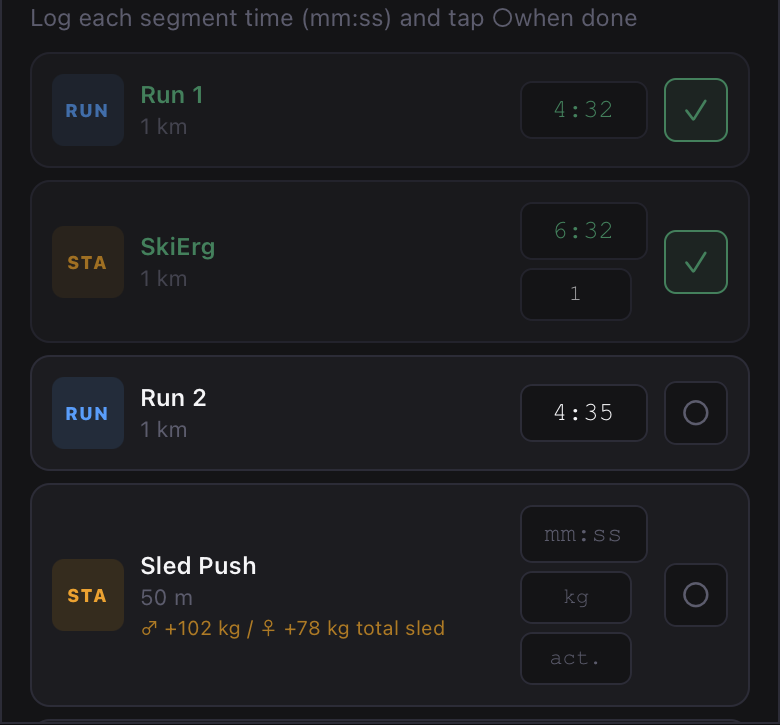
Segment times as you go, with the division load on the station.
The percentile is an estimate, and the app says so on the screen. So is a partial workout.
Finish-time percentiles come from published major-race distributions, split by category and sex — not official HYROX rankings, and not a leaderboard. Individual station ability varies. You get the working, not a badge.
Why one app
Your sled is a strength problem.
Nobody fixes a sled push with more running. You fix it with squats, split squats and loaded carries — and then you need to know whether that work is transferring. Most people end up with a lifting app, a running watch and no way to connect them.
Here the race simulation and the strength block sit in one history. e1RM trends, effective sets per muscle and weekly load are computed across both, so a heavy squat week shows up in your readiness before it shows up in your splits.
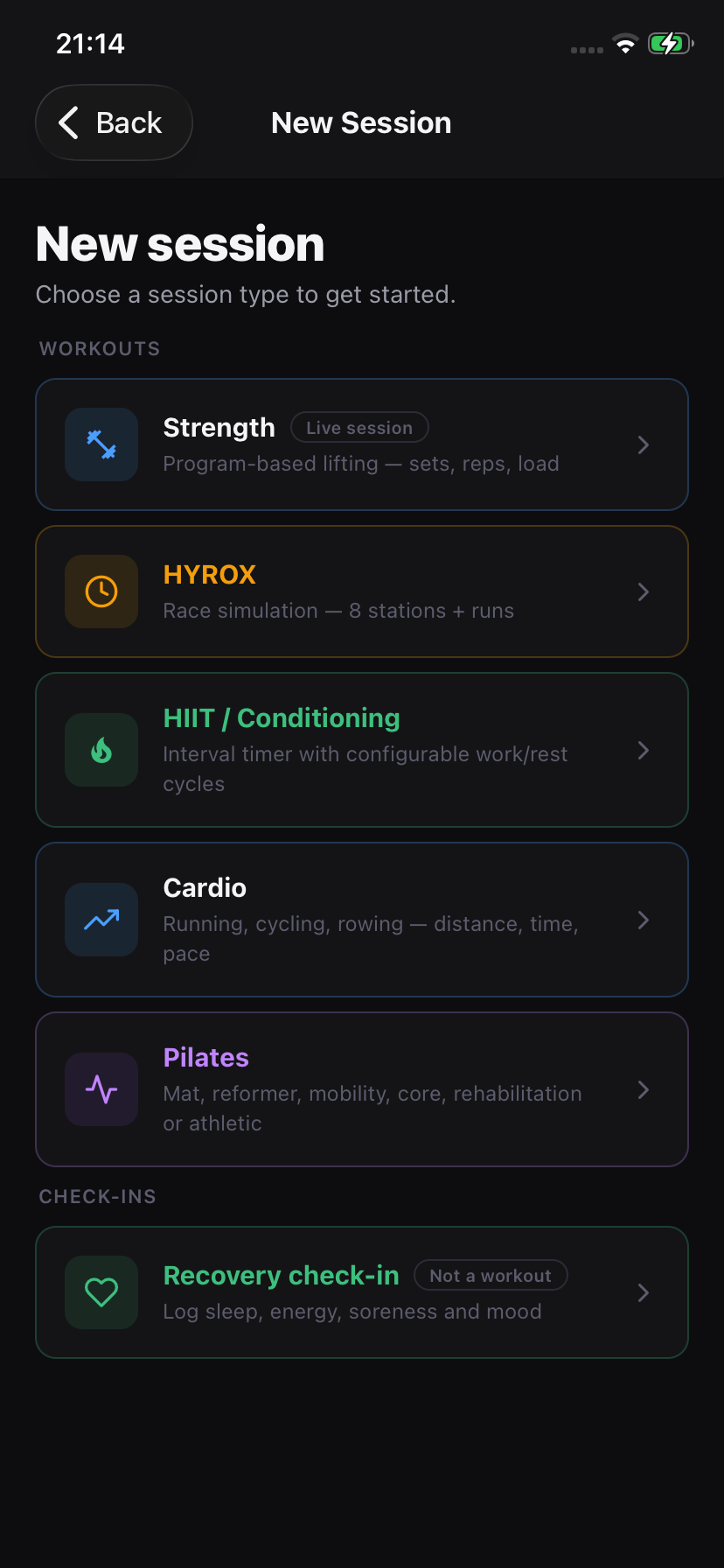
Race block
Build the twelve weeks, not just the session.
Programs, mesocycles and a calendar, so the taper is scheduled instead of improvised. Generate fills the gaps around it — compressed when you have forty minutes, full when you have the morning.
Conditioning
Intervals with a real timer.
Configurable work and rest cycles for the conditioning sessions between simulations, logged as sessions rather than notes. Cardio covers the running: distance, time, pace.
Recovery
Race week is a readiness problem.
Check in on sleep, energy, soreness and mood; keep a pain log. Insight weighs acute-to-chronic load against both, and says so plainly when you are ramping too fast.
Log the next simulation. Race the split table.
The web app is live. Native iOS and Android apps are next. Sign in with Google, Apple or email; your history syncs from the first set.